Back of house wall finishes: what the regulation actually asks for
Most people think commercial kitchen walls have to be stainless steel or white plastic sheet. The regulation says something narrower and more useful than that, and it leaves room for paint in the right positions. Two Salad Kitchen sites, one in Mayfair and one in the City, and what actually went where.
What does the law actually require?
Statutory hygiene regulations offer greater specification flexibility than is commonly assumed. Regulation (EC) No 852/2004, Annex II, Chapter II establishes that wall surfaces must be maintained in sound condition, easy to clean and, where necessary, easy to disinfect. The regulation stipulates the use of impervious, non-absorbent, washable and non-toxic materials up to an appropriate working height, unless the food business operator demonstrates to the competent authority that alternative finishes achieve equivalent hygiene performance.
Ceiling surfaces are governed separately under paragraph 1(c), requiring construction and finishes that prevent dirt accumulation, reduce condensation, inhibit mould growth and eliminate flaking particles.
Does that mean stainless steel throughout?
No. The primary legal test is whether the substrate is durable, hygienic and maintainable. While there is a strong operational presumption toward impervious finishes in wet or high-grease zones, which is why hygienic PVC wall cladding and stainless steel remain commercial standards, the regulation does not mandate a single proprietary material. Crucially, the height qualification acknowledges that performance demands vary as you move up the wall face.
Where each finish earns its place
Practical zoning on commercial catering sites typically follows three distinct tiers:
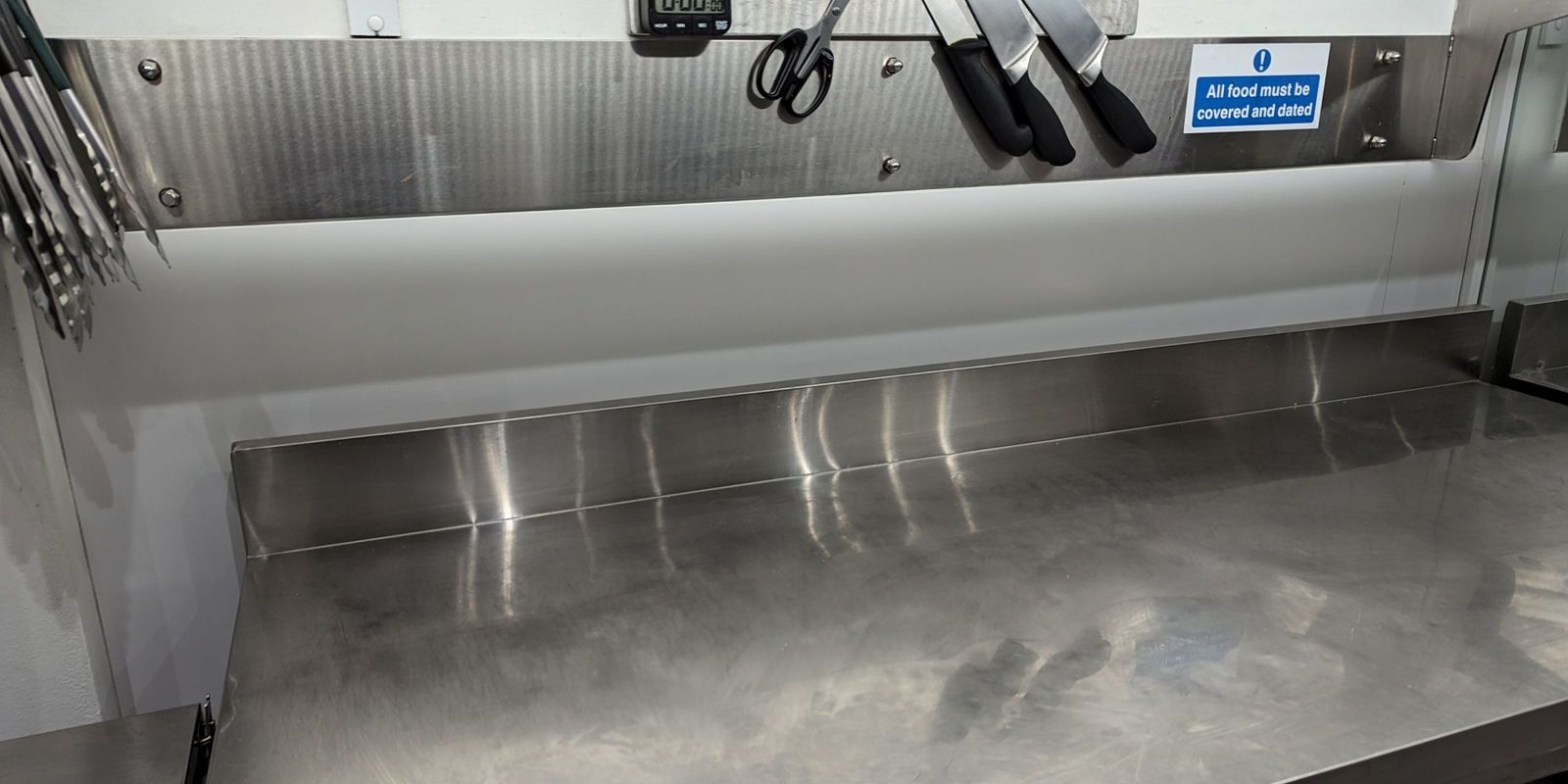
- Stainless steel: Installed directly behind cooklines and prep benches where surfaces endure high temperatures, knife impacts and aggressive degreasing.
- Hygienic wall cladding: Installed around pot-wash areas, hand-wash stations and dishwashers to resist continuous water splashback and chemical cleaning.
- Durable washable coatings: Applied above splash lines and across peripheral walls away from direct cooking or washing operations.
At the Avery Row site, all three finishes operate together. A stainless splashback protects the prep run, hygienic cladding shields the hand-wash area, and high-performance washable wall paint finishes the surrounding perimeter.
Installation logistics
At Avery Row, our team installed the hygienic wall cladding directly. The commercial cooking suite was carefully decommissioned and moved out, Altro Whiterock cladding was fitted and seam-welded across all food preparation perimeters behind the counter, and equipment was reinstated. Peripheral walls were then redecorated in specialist breathable coatings.
To protect commercial operations, works were scheduled during overnight shut-downs, ensuring the kitchen opened on schedule for morning service.
Why wall paint fails in wet zones
Coatings fail in commercial kitchens when applied in areas exposed to thermal shock, high-pressure rinsing or concentrated cleaning chemicals. In our initial survey at Avery Row, painted plaster behind a pre-rinse sink had degraded from continuous hose spray. The paint system had not failed prematurely through defect; it had simply been specified in a location requiring an impervious cladding system.
Heavy-duty floor coatings
Floor finishes must withstand grease, standing water, chemical detergents and constant wheeled traffic. At Queen Victoria Street, we resurfaced the commercial kitchen and stair strings with a high-durability epoxy coating. Floor finishes in commercial kitchens function as wearing layers that require planned maintenance and periodic recoating rather than permanent building elements.
What environmental health officers evaluate
Inspecting officers evaluate substrate integrity, cleanability and bacterial risk. Food Standards Agency guidance requires walls and floors to be sound, easy to disinfect, hard-wearing and maintained in good repair, without specifying proprietary brands. The Food Law Code of Practice requires inspecting officers to distinguish between mandatory legal standards and recommended best practice, leaving the operator free to select appropriate finishes that achieve statutory standards.
Pricing and commercial scope
Kitchen fit-out and redecoration pricing is dictated by out-of-hours working windows and equipment coordination. Quotations specify whether works are scheduled for overnight closures, split shifts or planned shutdown periods, ensuring zero disruption to food service.
Summary
Statutory regulations require cleanable, durable and non-absorbent surfaces up to operational heights. The most cost-effective and compliant commercial kitchen specification combines stainless steel behind cooking equipment, hygienic PVC cladding across wash areas, and durable washable coatings elsewhere. For planned commercial refurbishments, our property maintenance and painting and decorating teams deliver seamless multi-trade fit-outs.
Specifying a commercial kitchen
Identify the heat sources, washing stations and high-wear zones. We advise on the optimum boundary between hygienic cladding and protective coatings to ensure environmental health compliance without unnecessary capital expense.
Sources
- Regulation (EC) No 852/2004 on the hygiene of foodstuffs, Annex II, Chapter II, as it has effect in UK law https://www.legislation.gov.uk/eur/2004/852/annex/II/chapter/II
Tell us about the project.
We reply within one working hour, 7:30am to 5pm, Monday to Friday. Outside those hours, first thing the next working morning.
Enquiry form
Thank you. Someone from our office will call or email you within the hour if it is a working day, or first thing the next working morning.