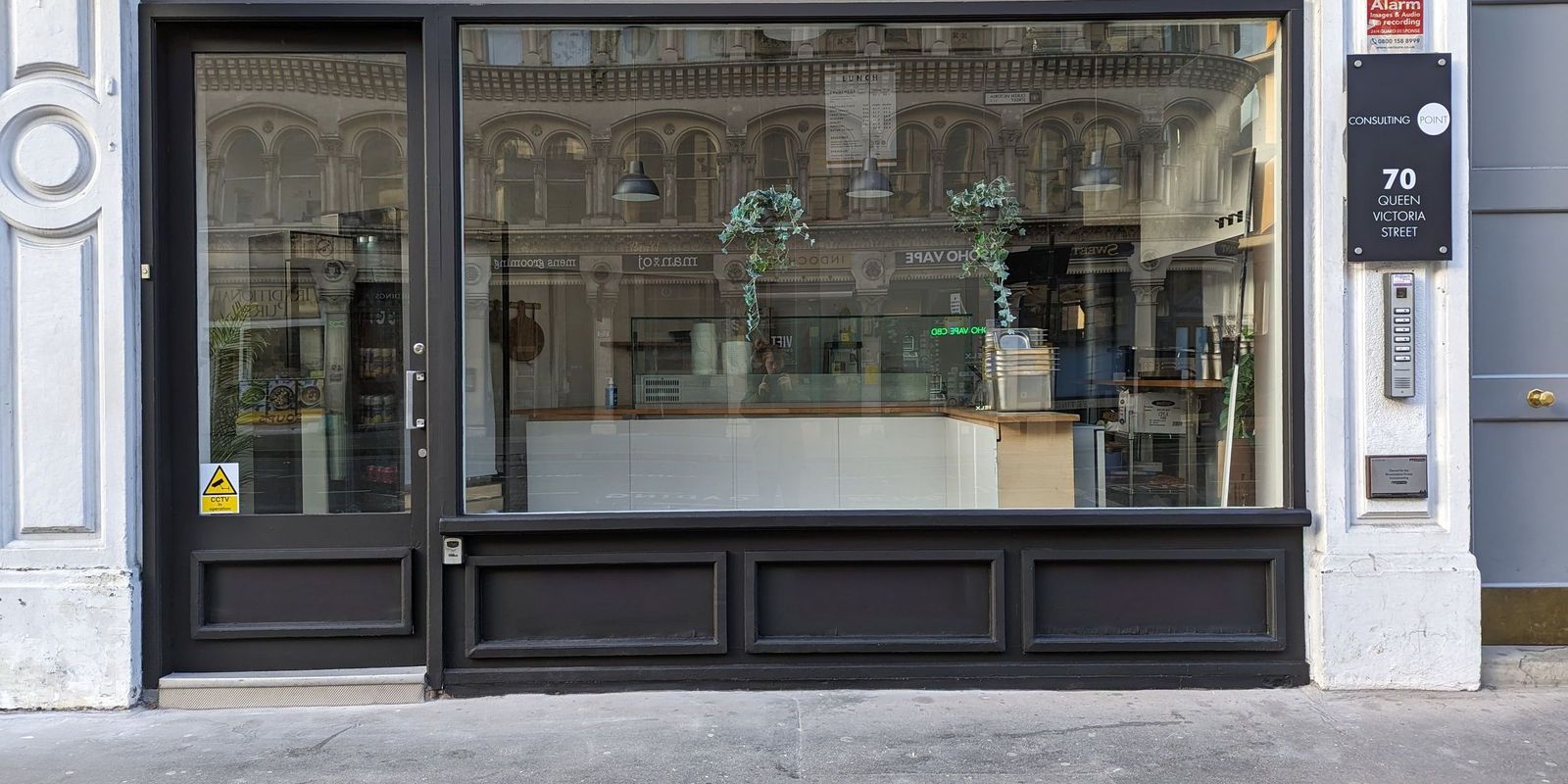
Repainting a City shopfront: the damage is at the bottom
A shopfront is the only part of a business that works when the business is shut. In the City it also takes more punishment than any other elevation on the building, and in our experience almost all of it in the bottom metre. Two City units, and what the frames show.
Why does a shopfront fail at the bottom?
Because that is where moisture and footway traffic concentrate. Rainwater washes down the frontage and collects on horizontal surfaces, while pavement splashback strikes the base. Deliveries, refuse bins, foot traffic and cleaning equipment all strike the lower metre. By contrast, high-level fascias endure minimal physical impact.
Our condition photography on Queen Victoria Street illustrates this failure pattern. Paint has deteriorated at the base of the stone pilasters and across the plinth along the pavement line, while high-level coatings remain sound.
What is actually different about a City frontage?
Trading hours and pavement congestion. City premises experience peak footfall during typical daytime decorating hours and clear out during evenings and weekends. Redecoration programmes must reflect these operational constraints from inception.
Job conditions dictate the delivery model. At Queen Victoria Street, work was executed out of hours to avoid business disruption. At Thurners on Garlick Hill, decoration was completed during the pre-opening fit-out period before commercial trading began.
What are the horizontal surfaces and why do they matter?
The cill, the stallriser cap and projecting architectural mouldings. At Thurners, the sloping timber cill spans the entire frontage and returns around the street corner. Sloping surfaces shed rainwater but retain standing pools at junctions, placing maximum physical stress on the decorative coating. Quotes prepared from across the street routinely miss degradation on these horizontal faces.
What should you check before repainting?
- Base of each pilaster and the plinth line at footway level.
- The cill and stallriser junctions along their full run.
- Corner returns, where differential building movement causes joints to open.
- Previous paint build-up on masonry or stone surrounds.
- Statutory planning and consent requirements before altering colour or finishes.
Does a repaint need consent?
External redecoration can engage multiple statutory regimes, and requirements must be confirmed with the relevant local planning authority prior to committing to colour schemes:
- Planning permission: Redecorating a building exterior generally falls under permitted development under Class C, Part 2, Schedule 2 of the Town and Country Planning (General Permitted Development) (England) Order 2015, provided finishes are not applied for advertisement purposes.
- Article 4 Directions: Local authorities may withdraw permitted development rights in specific commercial or historic streets. Westminster City Council, for example, restricts external painting rights in designated areas such as Relton Mews.
- Listed building consent: Consent is required where alterations affect the special architectural or historic interest of the building. Historic England advice indicates that like-for-like redecoration in matching paint type, colour and sheen rarely requires consent, but changing paint chemistry or altering historic colour schemes requires formal approval.
- Advertisement consent: Fascia lettering and branding fall under the Town and Country Planning (Control of Advertisements) (England) Regulations 2007. Altering sign colours, sizes or illumination triggers consent requirements.
Pricing and commercial scope
We price shopfronts based on lower-level restoration and horizontal surface preparation rather than aggregate elevation area. Quotations specify whether work is scheduled during standard hours, evenings or overnight shifts to ensure transparent project delivery.
Summary
Shopfronts degrade from the pavement up. Pilaster bases, plinths and cills dictate the required scope and cost. In dense urban locations, programme sequencing and out-of-hours working must be agreed from the start. For comprehensive exterior joinery and commercial redecoration, our exterior and period redecoration team manages both substrate repair and high-durability coatings.
Requesting a quotation
Provide four photographs: the shopfront straight on, a close-up of the pilaster bases, the cill along its run and any corner junction. That provides sufficient technical detail to prepare an accurate commercial quotation.
Tell us about the project.
We reply within one working hour, 7:30am to 5pm, Monday to Friday. Outside those hours, first thing the next working morning.
Enquiry form
Thank you. Someone from our office will call or email you within the hour if it is a working day, or first thing the next working morning.