Repainting exterior timber: why it fails at the edges first
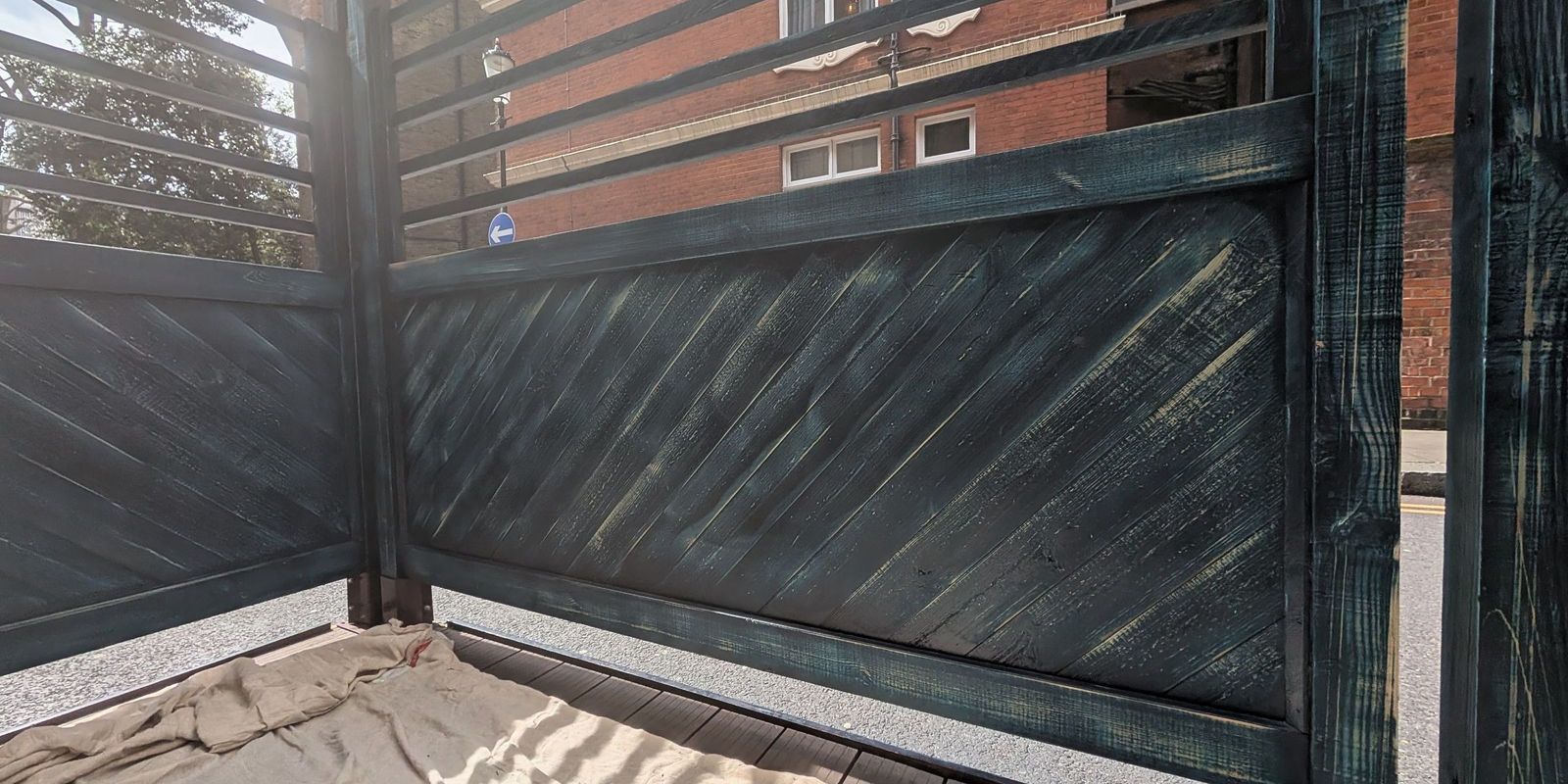
An outdoor dining structure fails faster than the building it stands against. It fails in a pattern too. Not evenly across the face, but at the joints, the end grain and the bottom rail. We repainted the terrace enclosure at Sal e Pepe in Knightsbridge in 2025, then took the terrace roof off and carried out the carpentry that followed. This is what the failure looked like and what the preparation involved.
Why does an outdoor structure fail faster than the building behind it?
Because the weather reaches every face of it. A masonry wall faces the weather on one side. A freestanding timber enclosure exposes both faces, the top edges, the underside of every rail and the cut end of every board. It also moves constantly, expanding and contracting with temperature and humidity shifts. Every coat of paint applied to it must flex alongside the substrate.
Where does the failure actually start?
At the end grain and the joints. Wood is far more permeable along the grain than across it, which is why moisture enters fastest wherever a board or rail has been cut. Research by Rowell and Bongers demonstrates that moisture entering wood end grain is the primary driver of coating failure at corners, joints and end-to-end cladding. The same mechanism governs slatted outdoor enclosures, which consist almost entirely of cut edges and joints.
Moisture drawn into unsealed end grain raises the moisture content of the timber beneath the paint film. Because the surface coating slows natural drying, the trapped moisture causes the wood to swell and contract repeatedly. That continuous movement stresses the paint film until adhesion breaks, accelerating substrate decay.
End grain sealing is only effective when using the correct formulation. Building Research Establishment trials established that solvent-thinned wood primers are particularly effective at penetrating and sealing end grain. By contrast, long-term trials indicate that standard brush-applied waterborne acrylic sealers are largely ineffective on untreated external timber.
Is it the paint's fault?
Usually not. Premature coating failure stems more often from inadequate preparation, high moisture content in the timber when paint was applied, or natural weathering. An exterior coating on an exposed structure in central London is a sacrificial finish. It has a finite working life. The critical commercial question is whether routine redecoration is scheduled before the underlying joinery degrades, ensuring the contractor inherits a sound substrate rather than rotted timber.
What does the preparation actually involve?
Stripping the failed coating back to sound timber, which on a weathered structure means stripping the majority of the surface. Cleaning down thoroughly, allowing the substrate to dry completely, treating any local rot, and rebuilding the protective system. Particular attention must be given to end grain and bottom rails, where previous coatings failed first.
At Sal e Pepe, the specification covered protecting the terrace decking, sanding all woodwork thoroughly, applying two coats of exterior wood hardener to vulnerable areas, and making good with two-part exterior grade wood filler before fine filling and sanding. The joinery was primed with two coats of exterior grade wood primer, lightly abraded between coats, and finished with two to three coats of exterior wood paint in Farrow and Ball.
Programme and site logistics
Site duration depends on substrate condition and weather. For an enclosure of this scale, the programme covers surface preparation, stabilisation, multi-coat application and drying intervals, followed by any structural carpentry adjustments. On active commercial premises, works are phased around trading hours to protect ongoing guest operations.
Pricing and commercial scope
We price exterior timber structures by assessing individual detail and condition rather than applying a flat square metre rate. Commercial cost sits primarily in preparation, edge sealing and joint work, rather than broad face area. Two structures of identical surface area can differ substantially in required labour hours based on the density of slats, joints and prior breakdown.
Summary
Exterior timber fails at edges and cut ends because end grain absorbs moisture fastest. Thorough preparation and correct primer selection represent the majority of the work and the investment. For wider building maintenance and facade care, our exterior and period redecoration service delivers comprehensive substrate repair and protective coatings across London.
Inspecting your structure
Examine the bottom rail, cut board ends and any joint that retains standing water. If the coating has failed in those vulnerable areas while remaining intact elsewhere, deterioration has begun. If bare timber has turned grey, moisture has penetrated the wood fibres. High-resolution photographs of those three junction points provide the detail needed for a clear technical assessment.
Sources
- Rowell and Bongers, *Role of Moisture in the Failure of Coatings on Wood*, Coatings 2017, 7(12), 219, doi 10.3390/coatings7120219 https://www.mdpi.com/2079-6412/7/12/219
Tell us about the project.
We reply within one working hour, 7:30am to 5pm, Monday to Friday. Outside those hours, first thing the next working morning.
Enquiry form
Thank you. Someone from our office will call or email you within the hour if it is a working day, or first thing the next working morning.