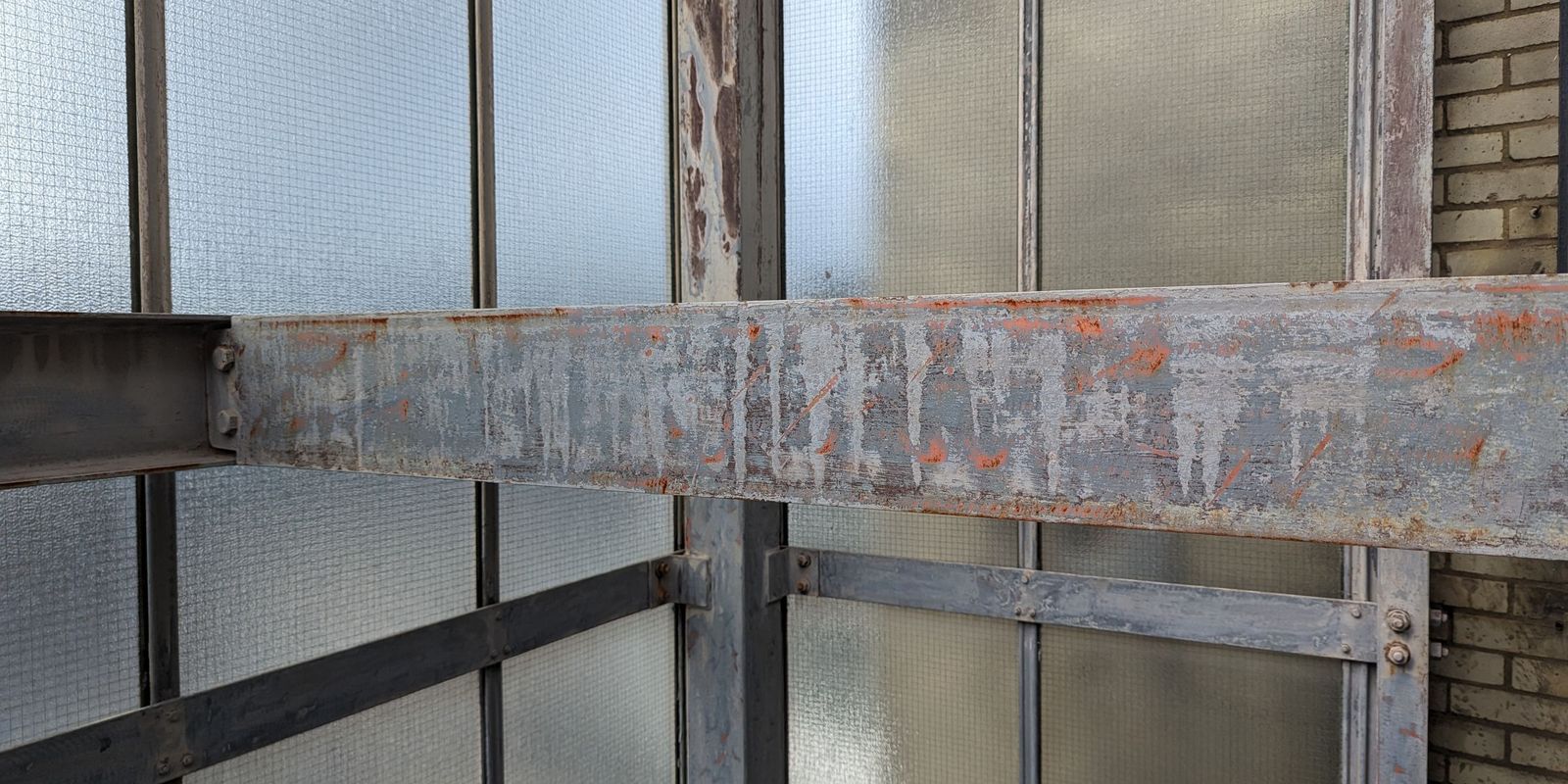
Fire escape repainting: what an external steel stair actually needs
We repainted the external steel fire escape at Sackville Street in Mayfair over a fortnight in October 2023, following the main building refurbishment. SFS is CHAS Elite accredited and SSIP assessed for both contractor and principal contractor scope. This guide explains what causes an external fire escape to fail, and what a proper, lasting repaint involves.
Who this is for. Managing agents, RTM and resident management company directors, building managers and main contractors with an external steel stair and a growing suspicion that it needs attention. We are a painting and decorating contractor. This is about the coating, the preparation and the specification. If the steel itself is in question, that is a structural engineer's job and not ours.
Why does rust start at the bolts rather than in the middle?
Because the overlaps are crevices. Capillary action draws water into them and it cannot get out. The oxygen inside runs out faster than fresh oxygen replaces it, and the tip of the crevice becomes a small concentrated anode where the corrosion rate rises sharply. The recognised advice is to avoid lap joints where you can and seal them where you cannot.
The mating faces of a bolted joint have their own name, faying surfaces, and steelwork guidance is explicit that they need thinking about separately from the surfaces you can see. That guidance calls fasteners out as particularly vulnerable, and the recognised remedy is a stripe coat, meaning an extra coat applied locally to the fastener and the joint around it.
There is a second thing happening at the edges, and it is not corrosion at all. It is a coating problem. Where two surfaces meet at a sharp 90 degree arris, liquid paint will not hold the corner and pulls thin. The published remedy is to ease the corner, commonly to a radius of about 2mm, and to run a stripe coat along it.
Industry guidance from SteelConstruction.info notes that while crevice, pitting and bimetallic corrosion tend not to be significant for structural steelwork in the general case, connection zones remain the hardest areas to prepare and coat effectively. In practice, bolted junctions and crevices are where coating breakdown and corrosion appear first.
What preparation is realistic on a stair that stays in use?
Not blast cleaning, in most cases. BS EN ISO 8501-1 sets blast cleaning grades Sa 1 to Sa 3 and hand and power tool grades St 2 and St 3, in ascending order of cleanliness. We do not reproduce the standard's own wording here. What matters commercially is that, as SteelConstruction.info puts it, hand and power tool cleaning will not remove intact mill scale, and that the St grades exist precisely for situations where blast cleaning is not possible.
On a stair in central London with neighbours either side, full blast cleaning is rarely proportionate. At Sackville Street, where the block was unoccupied and the site was still live, the failed coatings came off mechanically, worked section by section behind protection and with dust extraction on the removal. So the honest specification is an St grade, and anyone writing Sa 2½ into a specification for hand and power tool work on a live stair is describing something that will not happen.
There is also a different standard for this work than for new steel. ISO 8501-1 covers uncoated steel, or steel once you have taken the previous coating off entirely. Where only the failed areas come off and sound paint stays, the reference is ISO 8501-2, preparation grades of previously coated steel after localised removal.
Two things change the quantity of work, and both are worth establishing before anyone prices it.
- How far the rust has progressed. ISO 8501-1 grades the initial surface condition from Grade A (largely adhering mill scale with little rust) to Grade D (general pitting visible across the steel). Pitted steel concentrates soluble iron salts that accelerate corrosion. A fire escape exhibiting visible breakdown is frequently at Grade C or D, requiring thorough mechanical remediation rather than a cosmetic abrade.
- What is already on it. Paint of unknown age may contain lead, and on a stair whose coating history nobody holds you have to assume it until someone tests it. HSE names the stripping and burning of old lead paint among the activities where workers are most at risk. The law is the Control of Lead at Work Regulations 2002, with HSE's Approved Code of Practice L132 supporting it. That is a survey question, not something to discover with a scraper in your hand.
How should you specify the coating?
Against BS EN ISO 12944, and without pretending to a certainty the standard itself does not claim. Part 2 classifies environments by corrosivity, C1 very low to C5 very high, with CX for offshore and the most aggressive industrial conditions, set by measured thickness loss in the first year of exposure.
Environment categories must be evaluated against the specific building rather than generalised. The ISO framework places urban and industrial atmospheres with moderate sulphur dioxide in C3, whilst higher exposure environments reach C4. In reality, corrosion rates are governed by the immediate micro-climate surrounding the structure: a stair situated in a damp, sheltered lightwell behaves differently from one on an exposed open elevation. Specification requires site-specific assessment of local exposure rather than an assumed default category.
The same standard sets durability ranges, which since the 2017 revision run low up to 7 years, medium 7 to 15, high 15 to 25 and very high over 25. A durability range is a planning parameter for a maintenance cycle. It is not a guarantee and not a warranty, and a contractor presenting it as one has misread it.
What we used at Sackville Street. We primed the stair in Rust-Oleum CombiPrimer, the anti-rust primer for the CombiColor system, and finished it in Rust-Oleum CombiColor, a direct to metal system. We picked out the nosing of every step in an anti-slip paint. That was the system for that stair. We price the system job by job rather than running a house default.
What actually goes wrong on site?
Conditions, mostly, rather than exotic failures. Three of them account for most breakdown on an external stair. Painting outside the dew point window. Leaving edges, welds and fasteners without a stripe coat, so the film goes thin exactly where it is needed most. And carrying dust off the preparation into the primer. None of them is difficult to avoid, and all three are cheaper to write into the specification than to argue about afterwards.
- Dew point. Do not paint when there is condensation on the steel, or when the humidity will affect application or drying. Normal practice is to measure the steel temperature with a contact thermometer and keep it at least 3°C above dew point. On a London stair in October that constrains the working day.
- Edges, welds and fasteners. These get a stripe coat, for the reason above. If the specification does not say so, you have designed the thin spots in.
- Dust after preparation. We check residual dust with a tape lift against a pictorial rating in BS EN ISO 8502-3. The standard gives quantity and size ratings and a method but sets no pass mark of its own, so a numeric dust level has to come from the specification or the coating manufacturer. Anyone quoting one as though the standard set it has misread it.
What is honestly known about anti-slip nosings?
The recognised UK benchmark for pedestrian slip resistance is the pendulum test value (PTV), where the Health and Safety Executive classifies 0 to 24 as high slip potential, 25 to 35 as moderate and 36 or above as low. The UK Slip Resistance Group recommends a minimum PTV of 36 in wet conditions.
Whilst standard PTV testing applies to solid treads and level walkways rather than open mesh grating, PTV 36 represents the accepted good-practice threshold across property management.
At SFS, our approach is practical and transparent. We specify and price high-contrast, anti-slip tread nosings as a distinct item rather than absorbing them into the general coating. Nosings are applied following the body finish coats, providing a clear visual contrast and durable slip resistance along the leading edge of every tread.
What does the law actually require?
Statutory duties sit with the designated responsible person under the Regulatory Reform (Fire Safety) Order 2005. General fire precautions under Article 4 require adequate measures regarding means of escape to ensure routes can be safely and effectively used at all times. Article 14 requires emergency routes and exits to be maintained clear, while Article 17 mandates that premises and facilities provided for fire safety must be kept in an efficient state, in efficient working order and in good repair.
The legislation establishes high-level functional obligations rather than specifying prescriptive repainting intervals or coating thicknesses for external stairs. However, Article 5(3) extends duties to anyone having control of premises, meaning contractors undertaking works on escape routes share responsibility for maintaining safe access during works.
Under the Fire Safety Act 2021 (commenced May 2022), the scope of the Fire Safety Order for multi-occupied residential buildings explicitly encompasses the external structure, external walls and common parts. Keeping external steel escape infrastructure sound, rust-free and readily navigable is therefore central to meeting building safety compliance.
One more, and it is design guidance for new work rather than a retrospective duty. Approved Document B says an external escape stair more than 6m in vertical extent should have protection from adverse weather, enough to prevent a build-up of snow or ice. It does not require full enclosure. We cite volume 2, buildings other than dwellings, at paragraph 3.32. The equivalent in volume 1, dwellings, is paragraph 3.71 for flats and paragraph 2.17 for dwellinghouses.
How we price and run it
Where an agent or surveyor sends a specification we price it line by line against its clauses, and where there is none we survey and write one first. On a stair that means getting to the connections rather than looking up from the yard. The full pricing approach is set out on our main contractors and developers page and our accreditations page carries the CHAS Elite and SSIP position. We write the preparation grade in honestly, as an St grade where blast cleaning is not realistic, and we say which parts we are taking back and which sound coating stays. We count repairs and areas of deep pitting at survey and confirm them from the access, because the extent of corrosion is the thing least visible from the ground. We fix the quotation against the specification and carry anything nobody can see at survey as a named provisional sum, rather than burying it in a rate.
We take a stair in sections rather than closing all of it. One section comes out of use at a time, with clear fire exits marked out while we work on it, so the building is never left without a route.
RAMS come from our operations director before we mobilise, and every new client gets a weekly written progress report with photographs. More on how we work with agents is on our managing agents and Section 20 page, and external steelwork sits alongside our exterior and period redecoration and property maintenance work. The stair in these photographs is part of the Sackville Street case study.
In one paragraph
An external steel fire escape fails at its bolted connections and its edges, not across its flat surfaces, because crevices hold water and paint pulls thin over sharp arrises. On a stair that stays in use, hand and power tool preparation to an St grade is what is realistic, and a specification calling for blast cleaning is describing something that will not happen. Specify against BS EN ISO 12944, treat the corrosivity category as a judgement rather than a fact and price the anti-slip nosings as their own item. The law requires the responsible person to keep the means of escape usable and maintained where necessary, but it names no interval and no standard for the stair itself.
If you are working out whether yours needs doing
- Is the rust concentrated at the bolts, plates and laps, or general across whole members? Concentrated is ordinary. General pitting is probably a structural conversation.
- Is the paint still adhering where it is not rusted? If sound coating remains over most of it, you are looking at localised preparation and overcoat under ISO 8501-2, not a strip and repaint.
- Can you get to it, and can it stay in use? That moves the price more than the paint does.
- What is on it now, and how old is it? Lead is a method question to settle before anyone starts.
Send photographs of the connections rather than of the whole stair, and we will tell you what we think.
This guide is information, not advice on your building. It describes published standards and the law as they stood in September 2026, with sources below.
Sources
- BS EN ISO 12944-2:2017, Corrosion protection of steel structures by protective paint systems, Part 2, Classification of environments. ISO https://www.iso.org/standard/64834.html
- BS EN ISO 12944-1:2017, Part 1, General introduction. ISO https://www.iso.org/standard/64833.html
- BS EN ISO 12944-5:2019, Part 5, Protective paint systems. ISO https://www.iso.org/standard/77795.html
- Corrosion of structural steel. SteelConstruction.info (BCSA, Steel for Life and SCI) https://www.steelconstruction.info/Corrosion_of_structural_steel
- Influence of design on corrosion. SteelConstruction.info https://steelconstruction.info/Influence_of_design_on_corrosion
- Surface preparation. SteelConstruction.info https://www.steelconstruction.info/Surface_preparation
- Paint coatings. SteelConstruction.info https://www.steelconstruction.info/Paint_coatings
- Corrosion protection. SteelConstruction.info https://steelconstruction.info/Corrosion_protection
- SCI Guidance Note 8.01, Preparing for effective corrosion protection, revision 4, 2015 https://www.steelconstruction.info/images/f/fc/GN_8-01.pdf
- BS EN ISO 8501-1:2007, Visual assessment of surface cleanliness, Part 1. ISO https://www.iso.org/standard/43426.html
- BS EN ISO 8501-2:1994, Part 2, previously coated substrates after localized removal. ISO https://www.iso.org/standard/15712.html
- A corrosion protection guide for steelwork exposed to atmospheric environments. Corus Construction and Industrial, 2004, hosted by the National Physical Laboratory http://resource.npl.co.uk/docs/science_technology/materials/life_management_of_materials/publications/online_guides/pdf/exposed_atmospheric_environments.pdf
- Regulatory Reform (Fire Safety) Order 2005, articles 3, 4, 5, 14 and 17. legislation.gov.uk https://www.legislation.gov.uk/uksi/2005/1541/article/17
- Fire Safety Act 2021, section 1. legislation.gov.uk https://www.legislation.gov.uk/ukpga/2021/24/section/1
- Approved Document B, fire safety, volume 2, 2019 edition incorporating 2020 and 2022 amendments, paragraphs 3.31 to 3.33. MHCLG https://assets.publishing.service.gov.uk/media/67d02361d5ec5ed9e09f5f07/Approved_Document_B__fire_safety__volume_2_-_Buildings_other_than_dwellings__2019_edition_incorporating_2020_and_2022_amendments.pdf
- Assessing the slip resistance of flooring, GEIS2. Health and Safety Executive https://www.hse.gov.uk/pubns/geis2.pdf
- What Makes Stairs Safer? UK Slip Resistance Group, April 2016 https://www.ukslipresistance.org.uk/wp-content/uploads/2017/09/UKSRG_safe_stairs_april_16.pdf
- Control of Lead at Work Regulations 2002. legislation.gov.uk https://www.legislation.gov.uk/uksi/2002/2676/contents
- Control of lead at work, Approved Code of Practice L132. Health and Safety Executive https://books.hse.gov.uk/gempdf/L132.pdf
- When are you most at risk, lead at work. Health and Safety Executive https://www.hse.gov.uk/lead/mostatrisk.htm
Tell us about the project.
We reply within one working hour, 7:30am to 5pm, Monday to Friday. Outside those hours, first thing the next working morning.
Enquiry form
Thank you. Someone from our office will call or email you within the hour if it is a working day, or first thing the next working morning.