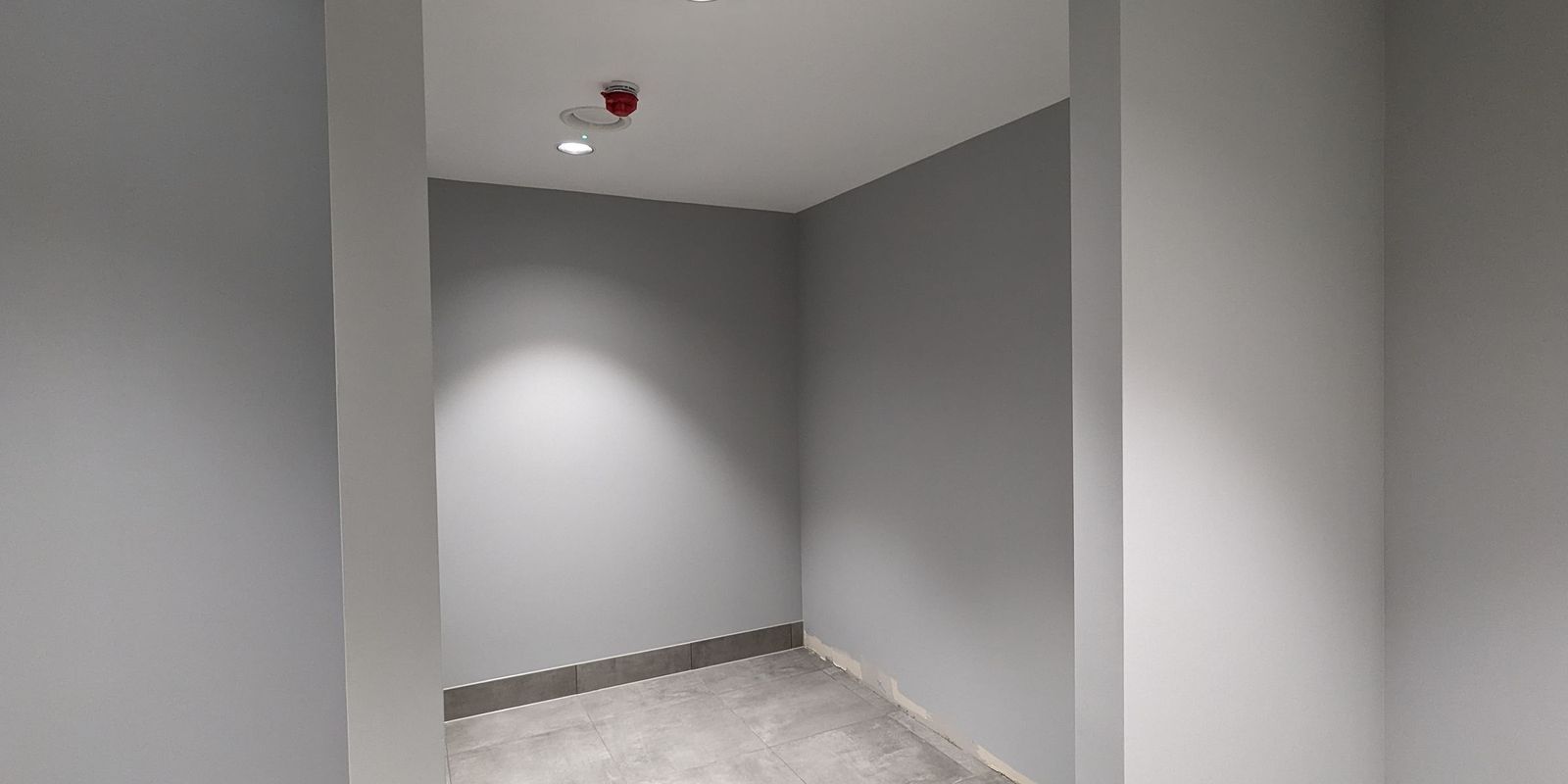
Making good after other trades, and why it is the line everyone argues about
At Sackville Street in Mayfair we painted four office floors, eight flats and all the communal areas for main contractor Pryer Construction. Then we came back behind the kitchen fitters and the electricians to repair and repaint what they had opened up. SFS is CHAS Elite accredited and SSIP assessed for contractor and principal contractor scope, set out on our accreditations page. Making good is where decorating subcontracts go wrong.
Who this is for. Main contractors, project managers and quantity surveyors letting a decorating package on a fit-out or a refurbishment. We are a specialist painting and decorating contractor. We hold the principal contractor role under CDM 2015 on our own projects and work under other principal contractors on theirs.
What is making good, and why is it not touching up?
Making good is the repair and redecoration of finished surfaces that following trades have opened up, drilled, chased, scratched or knocked. On a fit-out or major refurbishment, this represents a coordinated second pass across the building.
The distinction that matters commercially is between touching up and making good. Touching up addresses minor scuffs or superficial marks on an otherwise sound surface. Making good involves substrate repair: raking out, filling, sanding, priming and recoating so that the repair integrates seamlessly. Recoating to a natural architectural break or across the entire wall plane is often necessary to achieve a uniform finish under critical lighting conditions.
Why is it the most argued line in a decorating subcontract?
Because it is usually the only line whose quantity cannot be measured directly off architectural drawings at tender. The extent of making good depends on the volume of subsequent trades, the care with which they install, their completion schedule and the penetrations they create. None of those factors falls within the decorating trade's scope.
A package priced with an unrealistically low making-good allowance will inevitably generate variations. The solution is clear commercial definition from the outset: making following-trade remedials measurable, transparent and properly scheduled.
What actually drives the cost?
Four primary factors drive the cost of making good:
- Volume and sequencing of following trades. Each trade returning after initial decoration creates another round of patching and cutting in. On the residential units at Sackville Street, walls and ceilings required methodical remediation following kitchen installations and secondary electrical fit-out.
- Substrate composition. Plaster chases, plasterboard cut-outs, screw holes and damaged beads each require specific preparation, compounds and curing times.
- Sheen level and colour choice. Deeper tones and higher sheen levels accentuate surface discrepancies, requiring higher levels of surface preparation before recoating. Dead-matt finishes in light neutrals are far more forgiving.
- Lighting angles. A repair that appears invisible under diffused lighting can show under glancing light from full-height glazing or downlights placed tight to a wall.
How should you write it into the subcontract?
Four clear stipulations prevent disputes at final account:
- Define the standard. Clarify whether making good specifies localized spot repairs or repair and recoating to a natural architectural break.
- Quantify return visits. The number of return visits should be priced as an explicit item based on programme phasing.
- Establish damage protocols. Clarify contractual liability and sign-off procedures when following trades damage completed finishes.
- Coordinate programme timing. Ensure remedials take place only after damaging trades have fully demobilised from the work area.
We structure making good transparently based on project scale and programme duration. Making good is priced as an explicit itemized schedule or defined provisional sum rather than bundled into general rates. At Sackville Street, following-trade remedials were managed and instructed as a dedicated schedule, maintaining clear commercial visibility for both contractor and client.
Working on a live commercial site
On major refurbishments and fit-outs, works proceed within active, multi-trade environments. At Sackville Street, our team operated within an active principal contractor site across multiple phases, sequencing decoration around building services and second-fix trades.
All SFS site operatives hold current CSCS cards, participate fully in site inductions and adhere strictly to site safety rules. Project-specific RAMS are prepared and issued by our operations director prior to mobilisation. Collaborative sequencing is essential: agreeing clear programme milestones when damaging trades conclude ensures final topcoats and remedials are completed efficiently in a single, snag-free pass.
In one paragraph
Making good is the repair and redecoration of finished surfaces that following trades have opened up, and it is the only line in a decorating package nobody can measure at tender. Four things drive it: how many trades follow and how late, the substrate, the sheen and colour and the light. A patch on a matt wall under grazing light shows, so the plane comes back to a natural break. Write into the subcontract what making good means, how many visits it gets, who pays when a following trade causes the damage and when it happens in the programme. Those four sentences prevent most of the argument.
More on how we work with main contractors is on our main contractors and developers page. Our guide to Cat A fit out decoration covers the specification side of a fit-out decorating package, and the work in these photographs is in the Sackville Street case study.
This guide is information, not advice on your project. It is mostly our own practice, labelled as such, with the small number of third-party references sourced below.
Sources
- Drywall jointing and finishing, surface quality level classifications. UEEP and Eurogypsum http://www.eurogypsum.org/wp-content/uploads/2015/04/EUROGYPSUMFINSHINGUK.pdf
- Blueprint section 7, finishing plasterboard, v3 March 2022. Siniat https://516331.fs1.hubspotusercontent-na1.net/hubfs/516331/Blueprint%20Sections/SINIAT%20Blueprint%20v3_2022%20March_Section%207%20Finishing%20Plasterboard.pdf
- Glancing light, minimising the effects of critical lighting on plasterboard walls and ceilings, July 2014. CSR Gyprock, Australia https://celumcsrcomaublobs.blob.core.windows.net/celum/55181_yConnect_Document_gyprock-482-glancing_light-201808.pdf
Tell us about the project.
We reply within one working hour, 7:30am to 5pm, Monday to Friday. Outside those hours, first thing the next working morning.
Enquiry form
Thank you. Someone from our office will call or email you within the hour if it is a working day, or first thing the next working morning.